

DOCSIS 4.0: A Working Engineer’s Tutorial
# DOCSIS 4.0: A Working Engineer’s Tutorial
*Written for the engineer who is new to cable access networks and needs to become genuinely useful, not just conversant.*
Last revised: September 2026
—
## A Note Before We Start
I want to be honest with you about two things.
**First, about this document.** Every technical claim below is footnoted to a source, and where I could reach the actual CableLabs specification text I used that in preference to anything else. Where I am estimating rather than quoting, I say so plainly and show my assumptions. Where published figures don’t reconcile with my own arithmetic, I tell you that too, rather than papering over it. You will be a better engineer for knowing which numbers are load-bearing and which are marketing.
**Second, about me.** I have spent enough time around this technology to have opinions, and enough time to know that the plant always has the final word. DOCSIS 4.0 is a genuinely elegant piece of engineering sitting on top of a physical network built over fifty years by people who had no idea what we would ask of it. Most of what makes this hard is not the specification. It is the coax.
Read this with a spectrum analyzer nearby, if you can. The concepts land differently once you have seen an OFDM haystack with your own eyes.
—
## Table of Contents
1. [Where DOCSIS 4.0 Came From](#1-where-docsis-40-came-from)
2. [First Principles: Why Duplexing Is the Whole Story](#2-first-principles-why-duplexing-is-the-whole-story)
3. [The Two Modes: FDD and FDX](#3-the-two-modes-fdd-and-fdx)
4. [FDD (Extended Spectrum DOCSIS) in Detail](#4-fdd-extended-spectrum-docsis-in-detail)
5. [FDX (Full Duplex DOCSIS) in Detail](#5-fdx-full-duplex-docsis-in-detail)
6. [The Physical Layer](#6-the-physical-layer)
7. [Where the Speed Numbers Come From](#7-where-the-speed-numbers-come-from)
8. [MAC and Upper Layers: What Actually Changed](#8-mac-and-upper-layers-what-actually-changed)
9. [Low Latency DOCSIS](#9-low-latency-docsis)
10. [Security: BPI+ V2](#10-security-bpi-v2)
11. [Operations: PNM, PMA, and DAA](#11-operations-pnm-pma-and-daa)
12. [Plant Realities](#12-plant-realities)
13. [Deployment Status](#13-deployment-status)
14. [What Comes After](#14-what-comes-after)
15. [Traps and Misconceptions](#15-traps-and-misconceptions)
16. [Glossary](#16-glossary)
17. [References](#17-references)
—
## 1. Where DOCSIS 4.0 Came From
### The lineage
DOCSIS 4.0 is the **sixth generation** of the DOCSIS specifications. This is not my label — the specification says so in its own scope section [1]. The generations run: DOCSIS 1.0/1.1, 2.0, 3.0, 3.1, 4.0.
The single most important architectural fact about DOCSIS 4.0 is this: **it is not a new physical layer.** It builds on the OFDM and OFDMA physical layer that DOCSIS 3.1 introduced, and extends it [1][2]. If you understand DOCSIS 3.1 deeply, you are perhaps 70% of the way to understanding DOCSIS 4.0. If you don’t, learn 3.1 first. I mean this seriously — attempting 4.0 without 3.1 is like reading the sequel first.
The specification puts it plainly: DOCSIS 4.0 “builds upon the previous generations of the DOCSIS specifications… leveraging the existing Media Access Control (MAC) and Physical (PHY) layers” and adds Full Duplex as “an expansion of the OFDM PHY layer introduced in the [DOCSIS 3.1] specification” [1].
### The timeline
| When | What |
|—|—|
| June 2016 | Full Duplex DOCSIS transitions from an innovation project to an industry-wide R&D effort led by CableLabs [3] |
| Aug 2019 | CableLabs moves FDX requirements out of DOCSIS 3.1 and into DOCSIS 4.0 [3]. First issued PHYv4.0 (I01) dated 15 Aug 2019 [1][4] |
| 26 Mar 2020 | CableLabs publicly releases the DOCSIS 4.0 specification suite, incorporating both Full Duplex and Extended Spectrum [2][5] |
| Jun 2023 | CableLabs and its subsidiary Kyrio open DOCSIS 4.0 cable modem certification; submissions accepted starting 26 June [6][7] |
| 2025 | Interop events demonstrate 14 Gbps and then 16.25 Gbps downstream in multi-vendor setups [8] |
| Jun 2026 | First devices reach DOCSIS 3.1 “Verified for Interoperability” status — the *initial* phase of the DOCSIS 4.0 certification journey [9] |
Note that middle-of-the-story detail carefully, because people get it wrong constantly: the specification was published in 2020, the *certification program* opened in 2023, and as of mid-2026 devices were still progressing through the certification pipeline [9]. “DOCSIS 4.0 was certified in 2023” is a claim you will see in the trade press. It is not what happened.
### The four pillars
CableLabs frames DOCSIS 4.0 as part of its “10G platform,” organized around four goals: **higher speed, lower latency, higher reliability, and enhanced security** [2][5]. This is marketing framing, but it is *useful* marketing framing, because the specification really does address all four, and if you only think about speed you will miss most of what changed.
### The headline numbers
DOCSIS 4.0 targets **up to 10 Gbps downstream and up to 6 Gbps upstream** [2][3][5]. For comparison, CableLabs states that current DOCSIS 3.1 cable modems support up to 5 Gbps downstream and 1.5 Gbps upstream [3].
So: downstream roughly doubles, upstream roughly quadruples [2]. **The upstream is the point.** Everything expensive and difficult in DOCSIS 4.0 exists to solve the upstream problem. Cable’s competitive weakness against fiber has never been download speed; it has been upload speed, and it has been that way since the architecture was designed in the 1970s for one-way television.
—
## 2. First Principles: Why Duplexing Is the Whole Story
Before any of the acronyms, you need one physical picture in your head.
### The plant
A cable network is a **tree-and-branch** architecture [1]. Signals originate at a headend or hub, travel over fiber to a **fiber node**, which converts optical to RF, and then travel over coaxial cable — through amplifiers, splitters, and **taps** — to homes. The specification assumes a maximum optical/electrical separation between CMTS and the most distant cable modem of 100 miles (160 km), though typical maximum separation is 10–15 miles [1].
Two consequences of tree-and-branch matter enormously:
1. **The medium is shared.** Every modem hanging off a node sees, to varying degrees, what every other modem transmits.
2. **The plant is directional but not perfectly isolating.** Taps are directional couplers, and directional couplers have finite isolation. Signal leaks where you don’t want it.
Hold on to point 2. It is the entire reason FDX is hard.
### Duplexing: how up and down share one cable
A single coaxial cable carries both directions. Historically DOCSIS has separated them by **frequency** — the classic **frequency division duplex** arrangement, implemented physically with **diplex filters** in every amplifier and node.
The dividing line is called the **split**. The specification defines these precisely [1]:
| Name | Upstream upper band edge | Downstream lower band edge |
|—|—|—|
| Sub-split / extended sub-split | 30 MHz or 42 MHz | between 50 and 54 MHz |
| EuroDOCSIS-split | 65 MHz | 87.5 MHz |
| Mid-split | 85 MHz | 108 MHz |
| High-split | 204 MHz | 258 MHz |
*(These four definitions are quoted directly from the DOCSIS 4.0 PHY specification’s terms section [1].)*
Notice the gap between the upstream upper edge and the downstream lower edge in every row. That gap is the **guard band** the diplex filter needs in order to roll off. Filters are not brick walls.
### Why the split is expensive to change
Here is the thing a junior engineer needs to internalize early. Changing the split is not a software change. Every diplex filter in the path — in each node, in each amplifier — must physically pass the new frequencies in the new direction. Historically that meant a truck roll to every active device in the plant, and often replacing the device.
This single fact explains almost every architectural decision in DOCSIS 4.0. It explains why operators debate FDX versus ESD for years. It explains why “just move the split up” is never as easy as it sounds. It explains why some operators chose to build fiber instead.
### Two ways to get more upstream
Given that picture, there are exactly two things you can do:
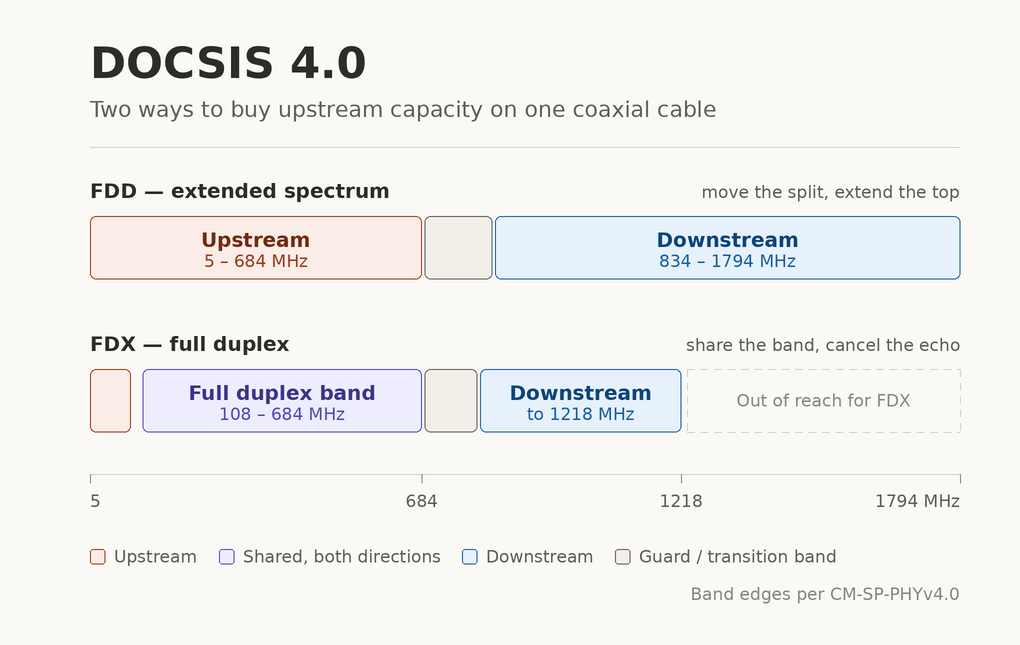
– **Move the split higher** — give the upstream more spectrum by taking it from the downstream, then replace the downstream spectrum by extending the top of the band. This is **FDD / Extended Spectrum DOCSIS**.
– **Stop dividing by frequency at all** — let upstream and downstream occupy the *same* frequencies at the *same* time, and cancel the resulting interference. This is **FDX**.
DOCSIS 4.0 specifies both [1][2][10]. Not as competitors that the industry failed to choose between, but deliberately, because the right answer depends on the plant you already own.
—
## 3. The Two Modes: FDD and FDX
Let me give you the compact comparison, then we’ll go deep on each.
| | **FDD (a.k.a. ESD)** | **FDX** |
|—|—|—|
| Duplexing | Frequency division, as always — but with much higher splits | Simultaneous US and DS in a shared band |
| Upstream reaches | up to 684 MHz [1][10] | up to 684 MHz (shared) [1] |
| Downstream reaches | up to 1794 MHz [1][10] | 1218 MHz [1] |
| Diplex filters | Still required, at new edges | Not used across the FDX band |
| Echo cancellation | Not required for the duplexing scheme itself | Required, at node and at modem [1] |
| Plant architecture | Works with amplifier cascades | Originally designed for N+0; FDX amplifiers extend this [11][12][13] |
| Primary champion | Charter, Cox, Mediacom, Cable One [14] | Comcast [14][15] |
The specification’s own framing: “DOCSIS 4.0 FDD supports legacy high-split and also provides extended splits up to 684 MHz in an operational band plan which is referred to as Ultra-high Split (UHS). DOCSIS 4.0 FDD also introduces expansion of usable downstream spectrum up to 1794 MHz. Both the FDX and FDD DOCSIS 4.0 alternatives are based on OFDM PHY” [1].
A few notes on terminology, because this trips people up:
– **ESD (“Extended Spectrum DOCSIS”)** is the common industry name; **FDD** is what the specification calls it. Same thing. The spec text uses FDD throughout [1].
– The two modes are **not simultaneous on one plant**. CableLabs is explicit: current products can support devices that operate on either type of network, “albeit not at the same time, as the outside plant will be configured for either one mode of operation or the other” [10].
– Vendors could submit modems for certification supporting FDX, ESD, or both — with a higher fee for both [7][16].
—
## 4. FDD (Extended Spectrum DOCSIS) in Detail
### The Ultra-High Splits
DOCSIS 4.0 FDD defines four new split options above high-split. The specification names them and gives an important detail most summaries omit — the downstream lower band edge is *not* a single fixed number, but a range, because it depends on what the plant components can actually do [1]:
| Scheme | Upstream upper band edge | Downstream lower band edge |
|—|—|—|
| **UHS-300** | 300 MHz | anywhere from 300 to 372 MHz |
| **UHS-396** | 396 MHz | anywhere from 396 to 492 MHz |
| **UHS-492** | 492 MHz | anywhere from 492 to 606 MHz |
| **UHS-684** | 684 MHz | anywhere from 684 to 834 MHz |
*(All four definitions quoted from the PHYv4.0 terms section [1].)*
Read that right-hand column carefully. It is a gift to operators. The wider you let the guard band be, the cheaper and more manufacturable your diplex filters get. An operator with marginal plant can pick UHS-396 with a 492 MHz downstream lower edge and accept losing ~96 MHz of downstream spectrum in exchange for filters that actually work. That is a real engineering trade, made in the field, and the spec deliberately leaves room for it.
### The upstream band structure
For FDD, the specification defines **FDD Upstream Allocated Spectrum** as the portion of upstream spectrum “comprised of upstream FDD channels between 108 MHz and the selected upstream upper band edge… further subdivided into a number of 96 MHz upstream OFDMA channels as appropriate for the selected upper band edge” [1].
So the structure is:
– **5–85 MHz** (or 5–204 MHz in the DOCSIS 3.1 high-split compatibility case): the legacy **Transmit Channel Set (TCS)** [1]
– **108 MHz to the UHS edge**: the **TCS_FDD**, carved into 96 MHz OFDMA channels [1]
For UHS-684, that’s 108 to 684 MHz = 576 MHz, which is exactly six 96 MHz channels. Add one more OFDMA channel down in the legacy 5–85 MHz band and you get **seven** — which is exactly the minimum OFDMA channel count CableLabs says a DOCSIS 4.0 modem must support [10].
*(That last connection is my own reading of why the number is seven, not something the specification states as rationale. It fits the arithmetic cleanly, and it is a useful mnemonic, but treat it as an engineer’s inference.)*
### The downstream
The specification defines the downstream spectrum for FDD devices as **258 MHz to 1794 MHz** [1]. That is 1536 MHz — a little over 1.5 GHz of downstream, and the 1794 MHz upper edge is what gets rounded to “1.8 GHz DOCSIS” in conversation.
Be careful with that 258 MHz figure. It is the *device capability floor* — the lowest downstream frequency an FDD device must handle, corresponding to the legacy high-split case. On a plant configured for UHS-396 or UHS-684, the downstream does not start at 258 MHz; it starts at the lower band edge in the table above. The device supports the full range; the plant uses a subset of it.
The spec also defines a **Legacy Transition Mode**: when an FDD node uses a downstream lower band edge below 258 MHz, it operates in a mode that transmits legacy video SC-QAM and other non-DOCSIS signals below 258 MHz, and “is restricted to 1,536 MHz of occupied downstream spectrum” [1]. This is the accommodation for operators still carrying broadcast video in the low band.
### A detail worth memorizing: downstream tilt
Coaxial cable attenuates high frequencies more than low ones — roughly as the square root of frequency. So the plant is designed with **tilt**: transmit the high frequencies hotter so they arrive at a usable level.
The specification pins this down numerically. The **Downstream Reference Power Spectral Density**, measured at Interface D (the RF output port of the node), is defined as a line “passing through the points 37.0 dBmV in 6 MHz centered at 111 MHz and 58.0 dBmV in 6 MHz centered at 1215 MHz” [1].
That’s **21 dB of tilt** across roughly 1.1 GHz. When you first see a DOCSIS 4.0 node output on a spectrum analyzer and it looks like a ski slope going *up*, this is why. It is not a fault.
—
## 5. FDX (Full Duplex DOCSIS) in Detail
Now the interesting one.
### The core idea, and the core problem
In FDX, the node transmits downstream and receives upstream **in the same frequencies at the same time**. The node can do this because it knows exactly what it is transmitting, so it can subtract its own transmission from what it receives — **echo cancellation**.
Cable modems cannot do the same trick as cleanly, and more importantly, they cannot cancel *each other*. Modem A transmitting upstream at 300 MHz will leak through the tap into modem B, which is trying to *receive* downstream at 300 MHz. Tap isolation is finite. Modem B is deaf.
So the elegant resolution, and the thing you must understand about FDX:
> **FDX is full duplex from the CMTS’s point of view, but frequency division duplex from each cable modem’s point of view.** [17][18]
The node genuinely does both at once. Each modem, at any instant, is either transmitting or receiving in a given sub-band — never both. The CMTS’s job is to orchestrate which modems do which, so that no modem is transmitting in a band where a nearby modem is trying to listen.
### The band plan
The specification is unusually crisp here:
– **Full Duplex Band: always 108–684 MHz** [1]. Not configurable. That range is the FDX band, full stop.
– **Full Duplex Allocated Spectrum**: the portion of the FDX band the operator actually turns on for full duplex. Five values are defined: **96, 192, 288, 384, and 576 MHz** [1].
– **Full Duplex Transition Band: 684–804 MHz** [1] — a buffer between FDX operation and the downstream-only spectrum above.
– Downstream spectrum for FDX devices: **108 MHz to 1218 MHz** [1].
Around the FDX band, a published NCTA technical paper describes the arrangement clearly: below the FDX band, up to 85 MHz is upstream-only; 102–108 MHz is downstream-only; above the FDX band, downstream-only [11].
Note that FDX runs inside the **same 1.2 GHz spectrum DOCSIS 3.1 networks already use** [12]. This is FDX’s great advantage — no 1.8 GHz plant upgrade required — and it is why Comcast pursued it.
Note also the **Full Duplex Dynamic Range Window (DRW_FDX)**, defined as the dynamic range window for upstream channels in the FDX band [1]. Managing the power difference between modems is much more delicate when their transmissions land on top of someone else’s downstream.
### Sounding, IGs, TGs, RBs, RBAs
Here is the machinery, in the order it happens. Learn these five terms and you will follow any FDX conversation.
**1. Sounding.** The CMTS orchestrates a measurement process in which modems transmit known signals and other modems measure and report the received level [17][18][19]. From the reported levels the CMTS derives the path losses among modems. The DOCSIS 4.0 PHY spec devotes a full section to sounding [1], with two methods in play — continuous wave tone (CWT) sounding and an OFDM Upstream Data Profile (OUDP) method [1].
**2. Interference Groups (IGs).** The specification defines an IG as “a group of cable modems with active channels in the Full Duplex Band that are susceptible to interfering with one another. The CMTS uses sounding to determine Interference Groups that are in turn mapped into Transmission Groups for Resource Block allocation” [1]. Physically, modems on the same tap or the same branch of the coax generally land in the same IG.
**3. Transmission Groups (TGs).** IGs get aggregated into a smaller number of TGs — “a logical grouping of cable modems using the Full Duplex Band, formed by the CMTS for the purpose of preventing transmissions from a cable modem from interfering with cable modems receiving in a downstream channel at the same time” [1]. All modems in a TG receive the same direction assignment.
**4. Resource Blocks (RBs).** The FDX Allocated Spectrum is divided into sub-bands. A Resource Block is “a Sub-band of the Full Duplex Allocated Spectrum assigned to a Transmission Group of Full Duplex cable modems” [1].
**5. Resource Block Assignment (RBA).** The assignment of a Resource Block to upstream or downstream operation [1]. Critically, the RBA can be changed **dynamically** as traffic demand shifts [17][18].
The whole flow, in one sentence: *sound the plant to learn who interferes with whom, group them, then hand each group a direction map across the sub-bands, and rewrite that map as demand changes.*
That last part is worth pausing on. This is a **software-defined split**, changing on the fly, per group of modems. Nothing in previous DOCSIS generations resembles it.
### Echo cancellation at the modem
The FDX modem also needs echo cancellation, because its own upstream transmission leaks into its own downstream receiver. The specification names two mechanisms it must contend with, and you will see these acronyms constantly [1]:
– **ACI — Adjacent Channel Interference**
– **ALI — Adjacent Leakage Interference**
The spec includes an **Echo Canceller Capabilities Profile (ECCP)** [1] and a **Zero-Bit-Loaded (ZBL) block** used for echo cancellation training [1] — a ZBL subcarrier being “a subcarrier with power but not carrying user data, although it could be modulated by a PRBS” [1]. In plain terms: the CMTS gives the modem a quiet, known region of spectrum in which to learn its own echo, without wasting the spectrum on nothing.
### The upstream tilt (yes, upstream)
Another number worth memorizing. The **Upstream Reference Power Spectral Density**, at Interface F (the modem’s RF port), is defined as a line “passing through the points 33.0 dBmV in 1.6 MHz centered at 108.8 MHz and 43.0 dBmV centered at 683.2 MHz” [1].
Ten dB of **uptilt in the upstream**. If you came up on legacy DOCSIS where upstream was flat, this is a genuinely new idea. Once the upstream reaches 684 MHz, cable loss matters in the return path the way it always did in the forward path.
### FDX-L modems
A nice piece of pragmatism. The spec defines an **FDX-L cable modem**: a DOCSIS 3.1 cable modem *with a software upgrade* that can either [1]:
– (a) transmit in the 108–204 MHz FDX upstream channels and receive in the 258–684 MHz FDX downstream channels, on a high-split network; or
– (b) receive in the 108–684 MHz FDX downstream channels on a mid-split network, with no access to upstream FDX channels.
CableLabs notes that although an FDX-L modem’s peak speeds don’t improve, it lets operators use the FDX spectrum flexibly rather than stranding it on the installed base [10]. This is how you avoid a flag day.
### N+0, and the amplifier that changed the calculus
FDX was originally conceived for **N+0** (“node plus zero”) plant — fiber deep enough that there are no amplifiers between the node and the home [11][12][13][20]. The reason is straightforward: an ordinary amplifier is a one-way device behind a diplex filter, and building an amplifier that simultaneously amplifies overlapping upstream and downstream signals is genuinely hard [11].
N+0 is expensive. Trade coverage in 2020–2021 was blunt that this requirement made FDX “a non-starter for the vast majority of cable operators” [12], and Extended Spectrum was widely framed as the way to reach 10G “without having to go to node plus zero” [20].
Then the FDX amplifier arrived. By housing echo cancellation in the amplifier rather than only in the node, FDX became deployable on plant with amplifier cascades [13]. Comcast received prototype FDX amplifiers from CommScope in 2023 [13], demonstrated symmetrical 4 Gbps in lab trials over a **six-amplifier cascade** [21], and stated the amplifier enables targeting FDX in N+6 architectures [13].
I flag this because a great deal of older writing — including material still circulating — states flatly that FDX requires N+0. That was true of the original design intent. It has not been true of what is deployable for several years. When you read anything about FDX, check its date.
—
## 6. The Physical Layer
DOCSIS 4.0 inherits its OFDM/OFDMA machinery from DOCSIS 3.1 [1]. Here is what you need, with the DOCSIS 3.1 heritage noted where relevant.
### Channels and numerology
| Parameter | Downstream OFDM | Upstream OFDMA |
|—|—|—|
| Channel bandwidth | 24 MHz to 192 MHz [22][23] | 6.4 MHz to 96 MHz [22] |
| Subcarrier spacing | 25 kHz or 50 kHz [1] | 25 kHz or 50 kHz [1] |
| FEC | LDPC plus an outer BCH code [22] | LDPC only [22] |
The specification defines **FFT duration** as the reciprocal of subcarrier spacing: “with 50 kHz subcarrier spacing, FFT duration is 20 µs, and with 25 kHz subcarrier spacing, FFT duration is 40 µs” [1]. Symbol duration is FFT duration plus the cyclic prefix [1].
The **cyclic prefix** is “a copy of the end of a symbol that is added to the beginning of the same symbol, in order to help mitigate the effects of micro-reflections and similar impairments” [1]. Windowing shapes the symbol edges to sharpen the signal in the frequency domain [1].
Note the glossary detail: “An upstream OFDMA channel bandwidth may be as much as 95 MHz” [1], while FDD upstream allocated spectrum is subdivided into “96 MHz upstream OFDMA channels” [1]. The 96 MHz is the channel raster; ~95 MHz is what is actually occupied after guard bands. Small distinction, but it will save you an argument someday.
### Modulation orders
This is an area where secondary sources contradict each other, so I’ll give you the version I can support and tell you where the ambiguity lies.
Per an industry technical reference: downstream OFDM “requires modulations up to 4096-QAM with optional support to 16384-QAM,” while upstream OFDMA “requires modulations up to 1024-QAM with optional support up to 4096-QAM” [22]. A separate technical guide describes DOCSIS 3.1 as adding “support for up to 4096-QAM with future optional 8192-QAM and 16384-QAM in the downstream; while supporting 1024-QAM and future optional 2048-QAM and 4096-QAM in the upstream” [24].
You will also find reputable presentations stating “up to 4096-QAM in the downstream and upstream” [25] without distinguishing mandatory from optional. Both statements can be true — one describes what the specification defines, the other what devices must support. **When precision matters, go to the specification text itself and check the MUST/SHOULD/MAY language.** The spec is explicit that “MUST” is an absolute requirement while “MAY” means “truly optional” [1].
For practical purposes: 4096-QAM is real and deployed. Cisco documents 4096-QAM support for OFDMA field deployment on both integrated CMTS and Remote PHY, starting with IOS XE Dublin 17.15.1w [26]. Higher orders exist on paper and require plant fidelity that most operators do not have.
### Profiles
Because each subcarrier can carry a different modulation order, the CMTS sends a **modulation profile** telling the modem how to interpret the signal. The specification defines a profile as “a set of parameters that defines how information is transmitted from a CMTS to a cable modem, or from a cable modem to a CMTS,” including modulation order, FEC, preamble, and guard interval [1]. In practice a downstream profile amounts to a per-subcarrier bit-loading assignment across the channel.
Different modems get different profiles. A modem with clean spectrum gets aggressive bit loading; a modem at the end of a long cascade gets a conservative one. This is the single biggest efficiency gain of OFDM over SC-QAM, and it is why Profile Management Applications exist (see §11).
### Channel counts for a DOCSIS 4.0 modem
CableLabs states that a DOCSIS 4.0 CM has a “required minimum support for five OFDM downstream channels and seven OFDMA channels,” and that “a CM with more channels and on a plant where the additional spectrum is enabled could get downstream speeds beyond 10 Gbps” [10].
Five downstream OFDM channels × 192 MHz = 960 MHz. Seven upstream OFDMA channels × 96 MHz = 672 MHz. Remember those two products; they are the basis of the capacity arithmetic in the next section.
### Regional variants
The specification includes three region-specific physical layer options for backward compatibility with legacy SC-QAM: North American 6 MHz channel spacing, European multi-program television distribution, and Chinese multi-program television distribution. All three “have equal priority and are not required to be interoperable,” and compliance requires conformance with one — not all three [1]. This matters if you work outside North America, and it surprises people who assume DOCSIS is monolithic.
—
## 7. Where the Speed Numbers Come From
I want to teach you how to reason about capacity, because you will be asked, and because it is a good habit to check published numbers against arithmetic.
**Everything in this section is my own approximation, clearly labelled.** The authoritative figures are CableLabs’; the arithmetic is mine, shown so you can check it.
### Downstream, worked through
Take one 192 MHz downstream OFDM channel with 50 kHz subcarrier spacing:
– Subcarriers: 192 MHz ÷ 50 kHz = **3,840**
– FFT duration at 50 kHz spacing: **20 µs** [1]
– Add a cyclic prefix — say 1.25 µs — giving a symbol duration of ~21.25 µs, so roughly **47,000 symbols/second**
– At 4096-QAM, each subcarrier carries **12 bits**
Raw: 3,840 × 12 × 47,000 ≈ **2.17 Gbps**
Now subtract overhead — LDPC parity, BCH, pilot subcarriers, excluded subcarriers, next-codeword-pointer overhead. A reasonable aggregate factor is 0.85–0.88, giving roughly **1.8–1.9 Gbps per 192 MHz channel**.
Five such channels: **roughly 9 to 9.5 Gbps**.
CableLabs states downstream capacities “could range from 9–10 Gbps” [10]. My estimate lands where it should. That is a good sign, and it tells you the “10 Gbps” figure is not fantasy — it is the modem’s five-channel minimum, well-loaded.
### Upstream, and an honest admission
CableLabs states that in an FDD plant, upstream capacities “could range from 4.2 Gbps (on a UHS-396 MHz plant), to 6 Gbps on a (UHS-684 MHz plant)” [10].
When I run the same arithmetic for UHS-396 — 108 to 396 MHz is 288 MHz, three 96 MHz OFDMA channels, plus the 5–85 MHz legacy band — I do not cleanly reproduce 4.2 Gbps at plausible modulation orders and overheads. My estimate comes out meaningfully lower.
I could quietly omit this. I would rather tell you, because the lesson is more valuable than the number: **published capacity figures embed assumptions the publisher does not always state** — modulation order, cyclic prefix length, pilot density, whether the figure is PHY-layer or MAC-layer throughput, whether legacy band contributions are included. When a capacity number matters to a decision, ask what assumptions produced it. If nobody can tell you, treat it as an upper bound.
Use CableLabs’ figures when quoting. Use your own arithmetic when sanity-checking. When they disagree, find out why before you build a plan on either.
### Demonstrated versus specified
Two data points from CableLabs’ own interop events, worth knowing precisely:
– At the **June 2025** DOCSIS 4.0 Interop, multiple CCAP cores, RPDs and modems from various suppliers in a distributed access architecture reached **14 Gbps** downstream across a multi-vendor network [8].
– At the **August 2025** DOCSIS 4.0 and DAA interop, vendors demonstrated **16.25 Gbps downstream throughput across two load-balanced DOCSIS 4.0 modems** [8].
That second one gets misquoted constantly as a single-modem figure. It was two modems, load-balanced. Read the qualifier.
Upstream speeds of **3 Gbps and 5.5 Gbps** were also demonstrated in different configurations at these events [8].
—
## 8. MAC and Upper Layers: What Actually Changed
### The specification suite
DOCSIS 4.0 is five specifications, not one [1]:
| Designation | Covers |
|—|—|
| CM-SP-PHYv4.0 | Physical layer |
| CM-SP-MULPIv4.0 | MAC and Upper Layer Protocols Interface |
| CM-SP-CM-OSSIv4.0 | Cable Modem Operations Support System Interface |
| CM-SP-CCAP-OSSIv4.0 | CCAP Operations Support System Interface |
| CM-SP-SECv4.0 | Security |
Each is revised over time through CableLabs’ Engineering Change process, so issue numbers advance — PHYv4.0 went I01 (Aug 2019) → I02 (Apr 2020) → I03 (Dec 2020) → I05 (Mar 2022), and MULPIv4.0 had reached at least I07 by late 2023 [1][4][28]. **Always check you are reading the current issue.** The CableLabs specification search is the authoritative source.
### Backward compatibility — the exact statement
Quoting the specification, because the details matter [1]:
> DOCSIS 4.0-compliant CMs interoperate seamlessly with DOCSIS 4.0, DOCSIS 3.1 and DOCSIS 3.0 CMTSs. DOCSIS 4.0-compliant CMTSs seamlessly support DOCSIS 4.0, DOCSIS 3.1, DOCSIS 3.0, DOCSIS 2.0, and DOCSIS 1.1 CMs.
Note what is absent from that second list: **DOCSIS 1.0**. Note also the asymmetry — a 4.0 modem works back to a 3.0 CMTS, but a 4.0 CMTS supports modems back to 1.1. These are not the same list, and the difference is deliberate.
### Distributed architecture is assumed
An underappreciated line in the spec: “For a DOCSIS 4.0 system, a distributed architecture is assumed. Thus, where DOCSIS 4.0 specifications use the ‘CMTS’ terminology it is implied to refer to legacy CMTS functionality as instantiated in the elements of the distributed architecture” [1].
In other words, DOCSIS 4.0 presumes **DAA** — Remote PHY or Remote MAC-PHY — rather than a monolithic chassis CMTS driving analog optics. The reference architecture in the spec shows RPDs and RMDs with a DOCSIS Core, connected by R-DEPI, R-UEPI, R-OOB, R-DTI and GCP interfaces [1]. If your mental model of a CMTS is still a chassis in a headend, update it.
### Multiple Transmit Channel mode
Worth knowing: “DOCSIS 3.1/4.0 cable modems require MTC Mode to be enabled in Registration” [1]. With MTC enabled, the modem and CMTS use Queue Depth Based Requesting and Continuous Concatenation and Fragmentation [1]. This is inherited, not new, but it is mandatory.
—
## 9. Low Latency DOCSIS
Speed gets the headlines. Latency is what users actually feel.
### What it is
Low Latency DOCSIS (LLD) was **introduced in DOCSIS 3.1 and carried forward into DOCSIS 4.0** [8][29]. Get that provenance right — it is not a DOCSIS 4.0 invention, though DOCSIS 4.0 is where it becomes broadly assumed.
The mechanism is a **dual-queue architecture** at both CMTS and cable modem [29][30]:
– A **Classic Service Flow** for queue-building traffic — think bulk TCP transfers using CUBIC [30]
– A **Low Latency Service Flow** for non-queue-building (NQB) traffic — gaming, voice, video conferencing [29][30]
The insight is that the two traffic types have incompatible needs. Bulk transfers *want* to fill a buffer; that is how loss-based congestion control discovers capacity. Interactive traffic is destroyed by that buffer. CableLabs’ framing is that segmenting them lets each get optimal performance without altering the overall bandwidth of the service [31].
### Classification and L4S
Traffic is classified using **DSCP markings or ECN bits** [29]. The IETF standardized an **NQB (Non-Queue-Building) DSCP** for exactly this purpose [32].
**L4S** — Low Latency, Low Loss, Scalable throughput — is the transport-layer companion. It relies on ECN: if a packet is classified to the Low Latency Service Flow and marked ECT(1) by the sender, the CMTS may mark Congestion Experienced if the queue starts to build [30]. The relevant IETF work is RFC 9330 (architecture), RFC 9331 (ECN protocol for L4S) and RFC 9332 (dual-queue coupled AQM) [29][33].
### Queue Protection
This is my favourite piece of the design, because it anticipates human nature.
A shared low-latency queue only works if everyone using it behaves. Some flows won’t — accidentally or deliberately. So DOCSIS includes a **Queue Protection** algorithm: if the queue is about to exceed a threshold delay, it rapidly identifies the flows most likely responsible and ejects selected packets, or all packets, of those flows [34][35].
This is documented in **RFC 9957** (May 2026), an Informational RFC explaining the algorithm introduced into DOCSIS at version 3.1 [35]. If you are implementing congestion control, or debugging why your “low latency” traffic got demoted, read it.
One subtlety that catches people: marking bulk traffic as low-latency to game the system **backfires**. The low latency queue is shorter, which is incompatible with what classic senders expect, so such traffic actually gets *worse* throughput [32].
—
## 10. Security: BPI+ V2
Every DOCSIS generation has tightened security. DOCSIS 4.0’s contribution is substantial and worth understanding even if you never touch a certificate.
### What was wrong with BPI+ V1
In DOCSIS 1.0 through 3.1, when Baseline Privacy Plus (BPI+ V1) is enabled, the CMTS directly authorizes a modem by giving it an Authorization Key, from which all further key material derives. **The CMTS is assumed trusted and its identity is not validated** [36][37].
Read that again. The network authenticates the device; the device does not authenticate the network. That was a defensible design in 1999. It is not one now.
### What BPI+ V2 adds
The DOCSIS 4.0 Security specification introduces BPI+ V2 with [36][37]:
– **Mutual Message Authentication (MMA/MA).** Modems digitally sign Authorization Request messages, “thus eliminating the possibility for an attacker to substitute the CM certificate with another one.” CMTSs must authenticate their own Authorization Reply messages [36].
– **Perfect Forward Secrecy (PFS).** Unlike V1, “the new authentication framework requires both parties to participate in the derivation of the Authorization Key from authenticated public parameters” [36]. Compromising a long-term key does not retroactively decrypt captured sessions.
– **Full algorithm agility** — the ability to change cryptographic algorithms without redesigning the protocol [36][37].
– **Downgrade attack protection** [36].
– **Removal of the RSA dependency**, with modern key exchange mechanisms aligned to **TLS 1.3** [37].
– **Enhanced revocation checking**, supporting both **OCSP and CRL** in DOCSIS 4.0 certificates [37].
### The transition
CableLabs was pragmatic here. DOCSIS 4.0 “allows for a transitioning period where devices are still allowed to use BPI+ V1,” because enabling V2 imposes new operational requirements — networks must procure and renew DOCSIS credentials [36]. BPI+ V1 continues to be supported; V2 “can be enabled as needed” [37].
If you take one thing from this section: **BPI+ V2 is not automatic.** It is a capability that has to be turned on, and turning it on has a PKI operations cost. Ask whether your network has actually enabled it.
—
## 11. Operations: PNM, PMA, and DAA
Three operational technologies you will meet immediately.
### Proactive Network Maintenance (PNM)
Section 9 of the PHY specification is devoted to PNM [1]. The idea is to use measurements the modems and CMTS already make — spectrum captures, RxMER per subcarrier, codeword error ratios, pre-equalizer coefficients — to detect plant degradation *before* customers notice.
CableLabs describes reliability as something that “must be planned into the network,” with DOCSIS including “methods to proactively identify and address network issues before consumers are even aware of them” [5]. In DOCSIS 4.0, PNM stops being a nice-to-have. With 1.8 GHz plant, higher-order modulation and much tighter margins, you cannot operate on customer complaints.
### Profile Management Application (PMA)
Recall from §6 that each subcarrier gets its own bit loading. Now count: CableLabs points out that with four OFDM channels per port, ten ports per line card, and ten line cards, you have “over a couple of million subcarriers requiring a specific configuration” [38]. Nobody configures that by hand.
A PMA is an external application that [39][40]:
1. Collects per-subcarrier **RxMER** data from modems and CMTSs, plus performance data such as codeword error ratios
2. Runs clustering algorithms to group modems with similar signal-to-noise signatures across the channel
3. Computes an optimized profile for each group, balancing capacity against robustness
4. Configures those profiles on the CMTS and assigns modems to them
CableLabs’ own PMA implementation calculates profiles for a channel with roughly 200 modems in about 30 milliseconds on a single CPU process [38][39]. Upstream PMA works the same way, reading upstream RxMER and generating optimized OFDMA profiles [40].
On the vendor side, Cisco documents an upstream PMA flow in which the PMA reads RxMER data via the PNM MIB, computes optimal mini-slot bit-loading (MSBL) overrides, and pushes them to the CMTS, which then updates the UCD MAC management messages that carry the new profile content out to RPDs and modems [27]. That chain — measurement, computation, UCD, modem — is worth tracing once end to end. It will teach you more about how DOCSIS actually works than any diagram.
CableLabs now describes PMA and PNM together as “a vital part of network operations… as networks push toward higher utilization and complex channel configurations” [8].
### Distributed Access Architecture (DAA)
As noted in §8, DOCSIS 4.0 assumes DAA [1]. Operators have been “replacing older analog nodes with new remote PHY devices (RPDs)” [8], and virtualized, cloud-native CMTS platforms (**vCMTS**) are described by CableLabs as “a key part of the DOCSIS 4.0 story” [8].
The practical upshot: DOCSIS 4.0 work is as much a software and orchestration problem as an RF problem. If you are an RF engineer, learn some systems. If you are a software engineer, learn some RF. The interesting problems are in the seam.
—
## 12. Plant Realities
The specification is the easy part. Here is what actually consumes the schedule.
### Spectrum migration
To use 108–684 MHz for upstream or bi-directional traffic, an operator must first move whatever is currently there. CableLabs’ operator-preparation technical report is direct about this: operators “are typically going to have legacy SC-QAM channels, QAM video, and/or downstream OFDM channels utilizing spectrum that the operator will want to transition to upstream or bi-directional. Moving existing channels to a substantially higher frequency can be a non-trivial task and is one of the key tasks that operators can begin looking at today” [41].
The same report notes a prerequisite that sounds obvious and often isn’t: “The operator should already be operating a DOCSIS 3.1 network with both OFDM and OFDMA channels” [41].
### Passives, taps and amplifiers
Extending to 1.8 GHz means every passive component in the path must perform at 1.8 GHz. Taps, splitters, couplers — components installed decades ago and specified to 1 GHz or less. CableLabs describes operators evaluating “outside plant components, such as taps, passives, and amplifiers, along with RPDs, CCAP cores, and cable modems,” and deploying them in a sequence: “outside plant components first (e.g., the smart amplifiers), then DOCSIS 4.0 RPDs and CCAP cores, and ultimately the cable modems to the customer homes, along with any necessary passive component upgrades” [8].
That ordering is worth memorizing. It is the actual deployment sequence.
CableLabs’ operator-preparation report also flags **network powering requirements**, **new failure modes**, and changes to **self-install versus professional-install** requirements after a segment is upgraded [41]. Higher frequencies mean more amplifier gain stages, which means more current draw, which means power supply capacity you may not have.
### Cascade reduction
If you do choose to reduce your amplifier cascade — for FDX with N+0, or simply for performance — you are extending fiber. Industry technical writing notes that cascade reductions require fiber extensions connecting service groups to new nodes, and that few plants have plenty of spare fibers available [42]. This is construction work: permits, make-ready, boring, traffic control. It is measured in years, not quarters.
—
## 13. Deployment Status
*This section ages fastest. Verify before quoting it. Current as of September 2026.*
### Where things stand
CableLabs’ February 2026 assessment: “the conversation has shifted from what’s theoretically possible to what’s actually happening in the field,” with operators “in various stages of assessing and testing outside plant components and equipment” and some beginning deployment [8]. Deployments enabling FDX mode “have already seen great success, and the stage is set for successful deployments of frequency division duplex mode of operation as well” [8].
### By operator
– **Comcast** is the leading FDX deployer [14][8]. By early 2026 its DOCSIS 4.0 deployment was reported as “no longer concentrated in certain markets,” reaching “millions” of homes — up from roughly 1 million homes passed across about ten markets in 2024, against a total network passing about 65 million homes and businesses. Comcast had deployed about 225,000 digital nodes, with “tens of thousands” DOCSIS 4.0-capable [43].
– **Charter** is pursuing FDD/ESD with a multi-phase HFC upgrade. Its CEO said in March 2026 that the upgrade would be about 50% complete by the end of 2026 [44].
– **Cox** has been acquired by Charter. Among the regulatory conditions, the California PUC required at least $275 million toward upgrading California networks to support symmetrical 1 Gbps speeds [45]. Charter has said it expects to accelerate DOCSIS 4.0 deployment in the Cox footprint [44][45].
– **Mediacom** deployed DOCSIS 4.0 commercially in Moline, Illinois in September 2025, using ATX 1.8 GHz ultra-high-split amplifiers, Harmonic’s virtualized platform and Remote PHY devices, and Hitron modems [46][47]. It is an **ESD/FDD** deployment.
That Mediacom launch is worth one more sentence, because it is the most honest picture of what “commercial deployment” means at this stage. The initial rollout served **14 customers off one node** [46], as the first phase of a wider plan for the Quad Cities service area. Mediacom’s CTO said the technology “is definitely ready” with live customers [46]. Both things are true simultaneously: it works, and it is early. Hold both.
### The broader picture
CableLabs’ analysis of FCC National Broadband Map data offers useful grounding. As of December 2024, **98% of residential locations served by cable operators have access to 1+ Gbps downstream tiers over HFC**. Over the June 2022 to December 2024 period, locations with access to 100+ Mbps *upstream* tiers rose from about 1% to 32%, and 1+ Gbps upstream reached 9% [8].
That upstream trend line is the real story. It is mostly DOCSIS 3.1 mid-split and high-split work — DOCSIS 4.0 is the next order of magnitude, not the first step.
### Certification
As covered in §1: the certification program opened June 2023 [6][7], and by June 2026 devices from GemTek, Hitron, MaxLinear, Sagemcom, Sercomm and Ubee — spanning Broadcom and MaxLinear chipsets, and covering both FDD and FDX modes — had reached DOCSIS 3.1 **Verified for Interoperability** status, described by CableLabs as “the initial phase of the DOCSIS 4.0 certification journey” [9]. Those devices “will continue through the DOCSIS 4.0 certification process, where more comprehensive testing will validate full compliance” [9].
Be precise about this when you talk to vendors and to management.
—
## 14. What Comes After
Two things are in motion, and knowing them will make you look like you read past the headlines.
### 3 GHz
CableLabs CEO Phil McKinney announced at SCTE TechExpo 2025 that CableLabs would begin industry work on enabling HFC to support DOCSIS transmission up to **3 GHz**, potentially enabling **up to 25 Gbps of aggregate capacity** [8].
Mechanically, this extends usable spectrum from 1.8 GHz to 3 GHz, “opening up spectrum for additional downstream OFDM channels” [8]. Importantly, the plan is for this to become **an optional annex to the existing DOCSIS 4.0 specifications**, not a new generation [8]. The work had begun as of early 2026 with participation from operators, modem vendors, silicon vendors, RPD manufacturers, CCAP core suppliers, and outside plant component makers [8].
### 6 GHz
Further out, CableLabs and industry partners are “analyzing and evaluating the potential of HFC networks all the way to 6 GHz,” which “could ultimately provide up to 50 Gbps of aggregate capacity” [8]. This is research, not specification work — analyses of plant characteristics, tap design, amplifier design, and upgrade paths [8]. Treat it accordingly.
—
## 15. Traps and Misconceptions
A collection of things I have seen catch capable people.
**”DOCSIS 4.0 means 1.8 GHz.”** Only in FDD mode. FDX runs to 1218 MHz [1]. If someone says “DOCSIS 4.0” and you don’t know which mode, you don’t know the band plan.
**”FDX requires N+0.”** True of the original design; not true of what has been deployable since FDX amplifiers arrived [13][21]. Check the date on anything you read about FDX.
**”FDX modems transmit and receive simultaneously.”** No. The *node* does. Each modem is FDD at any instant; the CMTS just moves the boundary dynamically [17][18].
**”The 16 Gbps interop was one modem.”** It was 16.25 Gbps across **two** load-balanced modems [8].
**”DOCSIS 4.0 modems were certified in 2023.”** The certification *program* opened in 2023 [6][7]. Devices were still working through it in mid-2026 [9].
**”Low Latency DOCSIS is new in 4.0.”** Introduced in 3.1, carried forward into 4.0 [8][29].
**”DOCSIS 4.0 is backward compatible with everything.”** A 4.0 CMTS supports modems back to DOCSIS 1.1 — not 1.0 [1].
**”The split is just a configuration setting.”** Every diplex filter in the path has to pass the new plan. It is hardware.
**”UHS-396 means downstream starts at 396 MHz.”** It means upstream *ends* at 396 MHz; downstream may start anywhere from 396 to 492 MHz depending on plant capability [1].
**”BPI+ V2 is on by default.”** It requires enablement and PKI operations work; V1 remains supported during transition [36][37].
**”10 Gbps downstream is what customers will get.”** It is the specification target with a minimum-configuration modem on fully enabled spectrum [10]. Marketed service tiers are considerably lower and depend on service group size, plant condition, and business decisions.
—
## 16. Glossary
Definitions marked † are quoted or closely paraphrased from the DOCSIS 4.0 PHY specification’s terms section [1].
| Term | Meaning |
|—|—|
| **ACI** | Adjacent Channel Interference † |
| **ALI** | Adjacent Leakage Interference † |
| **BPI+** | Baseline Privacy Interface Plus; DOCSIS authentication and encryption framework |
| **CCAP** | Converged Cable Access Platform |
| **CM / CMTS** | Cable Modem / Cable Modem Termination System † |
| **CWT** | Continuous Wave Tone (used in FDX sounding) † |
| **DAA** | Distributed Access Architecture |
| **ECCP** | Echo Canceller Capabilities Profile † |
| **ESD** | Extended Spectrum DOCSIS — the industry name for DOCSIS 4.0 FDD mode |
| **FDD** | Frequency Division Duplexing † |
| **FDX** | Full Duplex DOCSIS † |
| **FDX Band** | Always 108–684 MHz † |
| **FDX Allocated Spectrum** | The portion of the FDX Band configured for FDX operation; five values: 96, 192, 288, 384, 576 MHz † |
| **FDX Transition Band** | 684–804 MHz † |
| **FDX-L** | A DOCSIS 3.1 modem software-upgraded for limited FDX-band operation † |
| **High-split** | US upper edge 204 MHz, DS lower edge 258 MHz † |
| **IG** | Interference Group — modems susceptible to interfering with one another in the FDX band † |
| **Interface D / F** | Reference measurement points: node RF output / modem RF output † |
| **L4S** | Low Latency, Low Loss, Scalable throughput |
| **LDPC** | Low-Density Parity Check — the FEC used in DOCSIS 3.1/4.0 † |
| **LLD** | Low Latency DOCSIS |
| **Mid-split** | US upper edge 85 MHz, DS lower edge 108 MHz † |
| **MULPI** | MAC and Upper Layer Protocols Interface (specification) † |
| **NQB** | Non-Queue-Building traffic |
| **OFDM / OFDMA** | Orthogonal Frequency Division Multiplexing / Multiple Access † |
| **PLC** | PHY Link Channel — carries physical layer parameters from CMTS to modem † |
| **PMA** | Profile Management Application |
| **PNM** | Proactive Network Maintenance |
| **RB / RBA** | Resource Block / Resource Block Assignment † |
| **RPD / RMD** | Remote PHY Device / Remote MACPHY Device |
| **RxMER** | Receive Modulation Error Ratio |
| **SC-QAM** | Single Carrier QAM — the pre-DOCSIS 3.1 modulation † |
| **TCS / TCS_FDD / TCS_FDX** | Transmit Channel Set variants † |
| **TG** | Transmission Group — modems that receive a common direction assignment † |
| **UHS** | Ultra-High Split: UHS-300, UHS-396, UHS-492, UHS-684 † |
| **vCMTS** | Virtualized CMTS |
| **ZBL** | Zero-Bit-Loaded subcarrier — carries power but no user data † |
—
## 17. References
**Primary specification sources**
[1] Cable Television Laboratories, Inc., *Data-Over-Cable Service Interface Specifications DOCSIS 4.0 — Physical Layer Specification*, CM-SP-PHYv4.0-I03-201202, 2 December 2020. Retrieved from CableLabs. (Scope §1.1, compatibility §1.2.4, terms §3, overview §5.1, FDX PHY §7.2, FDD PHY §7.3, PNM §9.) — https://account.cablelabs.com/server/alfresco/553828be-22fe-4566-9d9d-85b79fb94a7e
[4] Cable Television Laboratories, Inc., *DOCSIS 4.0 Physical Layer Specification*, CM-SP-PHYv4.0-I02-200429, 29 April 2020. — https://account.cablelabs.com/server/alfresco/b16ac599-520b-4de3-8185-bcafc5743c91
[28] ITU-T J Series Supplement 10 (09/2022), *Cable networks — DOCSIS specification references*, listing CM-SP-PHYv4.0-I05-220328, CM-SP-SECv4.0-I04-220328 and related documents. — https://www.itu.int/rec/dologin_pub.asp?lang=e&id=T-REC-J.Sup10-202209-S!!PDF-E&type=items
[41] Cable Television Laboratories, Inc., *DOCSIS 4.0 Tools and Readiness: Cable Operator Preparations for DOCSIS 4.0 Technology Deployment* (technical report). — https://account.cablelabs.com/server/alfresco/bc2527a6-42f4-4ddb-83ac-62b656f0d0be
**CableLabs technology pages and engineering blogs**
[2] CableLabs, “On the Path to 10G: CableLabs Publishes DOCSIS 4.0 Specification,” 26 March 2020. — https://www.cablelabs.com/blog/on-the-path-to-10g-cablelabs-publishes-docsis-4-0-specification
[3] CableLabs, “DOCSIS 4.0 Technology” (technology overview page). — https://www.cablelabs.com/technologies/docsis-4-0-technology
[5] CableLabs / Broadband TV News, “CableLabs releases DOCSIS 4.0 Specification,” 27 March 2020. — https://www.broadbandtvnews.com/2020/03/27/cablelabs-releases-docsis-4-0-specification/
[6] CableLabs, “DOCSIS 4.0 Certification Available,” June 2023. — https://www.cablelabs.com/news/docsis-4-0-certification-available
[8] K. Sundaresan, CableLabs, “DOCSIS Technology: What’s Changed in the Past Year and Why It Matters,” 24 February 2026. *(Primary source for 2025 interop results, 3 GHz and 6 GHz roadmap, FCC broadband map analysis, PMA/PNM operational role.)* — https://www.cablelabs.com/blog/docsis-technology-past-year-update
[9] S. Kenny and K. Sundaresan, CableLabs, “Verified for Interoperability Milestone Advances Progress on DOCSIS 4.0 Networks,” 11 June 2026. — https://www.cablelabs.com/blog/docsis-4-0-verified-for-interoperability
[10] CableLabs, “The Evolution of DOCSIS Technology: Building the Future of Connectivity.” *(Source for minimum five OFDM / seven OFDMA channel support, FDD and FDX capacity ranges, FDX-L rationale.)* — https://www.cablelabs.com/blog/docsis-technology-evolution-building-the-future-of-connectivity
[17] CableLabs, “Full Duplex DOCSIS Technology Gets MAC Layer Support,” 2018. *(RBA, IG, TG definitions.)* — https://cablelabs.medium.com/full-duplex-docsis-technology-gets-mac-layer-support-f125d065b1d
[31] CableLabs, *Low Latency DOCSIS: Technology Overview*, 2019. — https://account.cablelabs.com/server/alfresco/0affb960-25f4-44f9-b747-74ad8555fd06
[32] CableLabs, “Low Latency DOCSIS” (project repository and explanatory notes). — https://github.com/cablelabs/lld
[36] M. Pala, CableLabs, “10G Integrity: The DOCSIS 4.0 Specification and Its New Authentication and Authorization Framework.” — https://www.cablelabs.com/blog/10g-integrity-the-docsis-4-0-specification-and-its-new-authentication-and-authorization-framework
[37] CableLabs, “The Cable Security Experience.” — https://www.cablelabs.com/blog/the-cable-security-experience
[38] K. Sundaresan, CableLabs, “The Profile Management Application: Optimizing DOCSIS 3.1 Networks.” *(Subcarrier configuration scale; clustering approach; ~30 ms computation for ~200 modems.)* — https://www.cablelabs.com/blog/tprofile-management-application-optimizing-docsis-3-1-networks
[39] CableLabs (Medium mirror of [38]), “The Profile Management Application: Optimizing DOCSIS 3.1 Networks.” — https://cablelabs.medium.com/the-profile-management-application-optimizing-docsis-3-1-networks-200e131ddc59
[40] CableLabs, “Increase Upstream Reliability and Capacity with Optimized Profiles.” — https://www.cablelabs.com/blog/increase-upstream-reliability-and-capacity-with-optimized-profiles
**IETF standards**
[33] RFC 9330 (L4S architecture), RFC 9331 (ECN protocol for L4S), RFC 9332 (Dual-Queue Coupled AQM). — https://www.rfc-editor.org/
[34] B. Briscoe et al., *The DOCSIS Queue Protection Algorithm to Preserve Low Latency* (Internet-Draft series). — https://datatracker.ietf.org/doc/html/draft-briscoe-docsis-q-protection-07
[35] RFC 9957, *The DOCSIS Queue Protection Algorithm to Preserve Low Latency*, May 2026 (Informational). — https://datatracker.ietf.org/doc/rfc9957/
**Industry technical papers and vendor documentation**
[11] W. Van Bruyssel et al., “Full Duplex DOCSIS over Active (N+X) Cable Networks,” NCTA Technical Papers, 2019. *(FDX band plan detail; diplexer-based, ALI-cancelling and active FDX amplifier approaches.)* — https://www.nctatechnicalpapers.com/Paper/2019/2019-full-duplex-docsis-over-active-n-x-cable-networks
[22] B. Volpe, “OFDM and OFDMA,” Broadband Library. *(Channel bandwidths, FEC differences, mandatory versus optional modulation orders.)* — https://broadbandlibrary.com/ofdma/
[23] R. Hranac, “A Closer Look at DOCSIS 3.1’s OFDM PHY Link Channel,” Broadband Library. — https://broadbandlibrary.com/a-closer-look-at-docsis-3-1s-ofdm-phy-link-channel/
[24] Incognito Software, “A Technical Guide to DOCSIS 3.1 and Beyond, Part 2: Technical Advantages.” — https://www.incognito.com/blog/a-technical-guide-to-docsis-3-1-and-beyond-part-2-technical-advantages/
[25] Cisco / SCTE, *DOCSIS 3.1 – An Overview* (SCTE webcast material). — https://webinabox.vtools.ieee.org/wibp_site_files/download/R50053?f=DOCSIS_3_1_overview19.pdf
[26] Cisco, *cBR Converged Broadband Routers — DOCSIS 3.1 OFDMA Channel Configuration*. *(4096-QAM OFDMA field deployment support.)* — https://www.cisco.com/c/en/us/td/docs/cable/cbr/configuration/guide/b_cbr_docsis_full_book_xe17_9/m_d31_ofdma_channel_config.html
[27] Cisco, *cBR Converged Broadband Routers — Profile Management Application*. — https://www.cisco.com/c/en/us/td/docs/cable/cbr/configuration/guide/b_cbr_docsis_full_book_xe17_18/m_profile-management-application.html
[29] Apposite Technologies, “Getting the Most Out of DOCSIS: Modern Standards, Latency, and Real-World Testing.” — https://apposite-tech.com/docsis-testing/
[30] Cisco, *cBR Converged Broadband Routers — Low Latency DOCSIS*. — https://www.cisco.com/c/en/us/td/docs/cable/cbr/configuration/guide/b_cbr_docsis_full_book_xe17_9/m-low-latency-docsis.html
[42] Corning / Broadband Technology Report, “Get Ready ‘Cause Here It Comes: DOCSIS 4.0.” — https://www.broadbandtechreport.com/docsis/article/14184376/get-ready-cause-here-it-comes-docsis-40
**Trade press (deployment and market status)**
[7] Light Reading, “CableLabs kicks off DOCSIS 4.0 modem certification program.” — https://www.lightreading.com/cable-technology/cablelabs-kicks-off-docsis-4-0-modem-certification-program
[12] Light Reading, “Full Duplex DOCSIS amplifier chatter heats up.” — https://www.lightreading.com/cable-technology/full-duplex-docsis-amplifier-chatter-heats-up
[13] Light Reading, “A critical piece of Comcast’s DOCSIS 4.0 puzzle begins to fall into place.” *(FDX amplifier, N+6 targeting.)* — https://www.lightreading.com/cable-technology/a-critical-piece-of-comcast-s-docsis-4-0-puzzle-begins-to-fall-into-place
[14] Light Reading, “2025 in review: Taking DOCSIS to the max.” — https://www.lightreading.com/cable-technology/2025-in-review-taking-docsis-to-the-max
[15] Light Reading, “Comcast ready to hit the accelerator on DOCSIS 4.0.” — https://www.lightreading.com/cable-technology/comcast-ready-to-hit-the-accelerator-on-docsis-4-0
[16] Fierce Network, “CableLabs will begin DOCSIS 4.0 certification later this month.” — https://www.fierce-network.com/telecom/cablelabs-will-begin-docsis-40-certification-later-month
[18] Lightwave / Broadband Technology Report, “Progress report: Full Duplex DOCSIS 3.1.” — https://broadbandtechreport.com/docsis/hybrid-fiber-coax/article/16449951/progress-report-full-duplex-docsis-31
[19] NCTI, “Full Duplex DOCSIS (FDX) Training” course description. *(Sounding process, IG management, N+0 and DAA requirements.)* — https://ncti.com/course/full-duplex-docsis
[20] Fierce Network, “CableLabs sticks a fork into DOCSIS 4.0 specification.” — https://www.fierce-network.com/telecom/cablelabs-sticks-a-fork-into-docsis-4-0-specification
[21] Light Reading, “Comcast hits symmetrical 4-Gig speeds with CommScope’s DOCSIS 4.0 FDX amps.” — https://www.lightreading.com/cable-technology/comcast-hits-symmetrical-4-gig-speeds-with-commscope-s-docsis-4-0-fdx-amps
[43] Light Reading, “Comcast’s DOCSIS 4.0 deployment now covers ‘millions’ of homes,” March 2026. — https://www.lightreading.com/cable-technology/comcast-s-docsis-4-0-deployment-now-covers-millions-of-homes
[44] Light Reading, “Charter’s HFC upgrade will be half done by year-end, CEO says,” March 2026. — https://www.lightreading.com/cable-technology/charter-s-hfc-upgrade-will-be-half-done-by-year-end-ceo-says
[45] Light Reading, “California PUC stamps Charter-Cox merger, with conditions,” August 2026. — https://www.lightreading.com/cable-technology/california-puc-stamps-charter-cox-merger-with-conditions
[46] Light Reading, “Mediacom boots up its first DOCSIS 4.0 deployment,” 25 September 2025. *(Source for the 14-customers-off-one-node detail and CTO commentary.)* — https://www.lightreading.com/cable-technology/mediacom-picks-dance-partners-for-its-first-docsis-4-0-deployment
[47] ATX Networks / Harmonic / Hitron joint press release, “ATX Networks, Harmonic, Hitron Selected for Mediacom’s DOCSIS 4.0 Customer Launch in Illinois,” 24 September 2025. — https://atx.com/company/press-release/atx-networks-harmonic-hitron-selected-for-mediacoms-docsis-4-0-customer-launch-in-illinois-showcasing-industry-leading-innovation-and-collaboration/
**Additional context**
[Corning/BSP] Corning, *Get Ready — ‘Cause Here it Comes: DOCSIS 4.0*. — https://www.bspdd.com/wp-content/uploads/2022/08/Corning-BSP-DOCSIS-4.0-paper.pdf
[Qorvo] Qorvo, “Innovation ‘Amplifies’ the Path to DOCSIS 4.0.” — https://www.qorvo.com/design-hub/technical-articles/innovation-amplifies-the-path-to-docsis-4-0
[CommScope] CommScope, “Unleashing DOCSIS 4.0 for HFC & FTTH.” — https://www.commscope.com/blog/2021/unleashing-docsis-4.0-for-hfc-ftth
—
## A Closing Word
If you remember nothing else, remember these five things:
1. **DOCSIS 4.0 is DOCSIS 3.1’s physical layer, extended.** Learn 3.1 properly.
2. **It exists to fix the upstream.** Every hard part traces back to that.
3. **There are two modes, and the mode determines everything else.** Always ask: FDD or FDX?
4. **FDX is full duplex at the node, frequency division at the modem.** The CMTS orchestrates the boundary.
5. **The specification is the easy part.** The plant, the powering, the passives and the spectrum migration are where the years go.
And one habit: when you encounter a number, ask where it came from. Ask whether it is a specification requirement, a demonstrated result, a vendor claim, or an estimate. The difference between a good engineer and a great one is very often just that question, asked consistently.
Go find a spectrum analyzer.
About the author
Greg Phillips is the founder and principal engineer of Think IT Data Solutions LLC. He has been building and operating physical infrastructure since 1984 — industrial control systems, the U.S. Navy Advanced Electronics Program, satellite communications at Comsat World Systems and Intelsat, and terrestrial transport and video distribution networks since. He founded Think IT Data Solutions in 2013.
Think IT Data Solutions builds and operates the layers underneath AI workloads — power and facilities, network transport, and GPU compute — for organizations that can’t run their most sensitive work on shared infrastructure.
Building something like this and want a second set of eyes on it? greg@thinkitdata.com · 678-643-4065